Getting involved in the fib
You are very welcome to join the fib’s activities in any of the following ways.
Login
As soon as they login, the fib members can access their profile and manage their account easily direclty from the fib network.
Membership
fib members receive a variety of benefits that keeps them up-to-date on the latest technical developments related to structural concrete. All fib members receive a subscription to the quarterly Structural Concrete Journal, discounts on symposium registration fees, the fib Directory, and access to the members-only section of the fib website. In addition, depending on their membership category, they receive fib’s technical bulletins (approximately four to five bulletins per year) and/or substantial discounts on their purchase.
Task Groups and Working Parties
One of the fib’s main activities is the publication of technical bulletins: state-of-the-art reports, recommendations, guides and model codes. Ten fib Commissions and several Special Activity Groups (SAG), including several Task Groups, develop and draft these bulletins, which form the cornerstone of fib’s work and are a major contribution to the international knowledge base on structural concrete. Members come from both research and industry, ensuring a balance between theoretical knowledge and relevant practical experience. New members are always welcome.
Commission members should be members of the fib; members of task groups are encouraged but not required to become fib members.
For the list of current commissions, task groups and their working programmes, visit the commissions page.



Model Code for Concrete Structures
A central aspect within the mission of the fib is the release of model codes on concrete structures and related subjects. These codes should serve worldwide as the guiding science-based documents offering in a code-type version the state of the art knowledge on the planning, design, construction, execution, operation or in service performance, maintenance, rehabilitation and dismantlement of new and existing concrete structures, respectively. The model codes should meet the latest requirements and technologies in view of aspects related to safety, serviceability, durability, resilience and sustainability of structures, recognizing economic, aesthetic and other needs of different societies.
Model codes
- fib Model Code for Concrete Structures 2020
- fib Model Code for Concrete Structures 2010
- CEB-FIP Model Code 1990 (PDF)
- CEB-FIP Model Code 1978 (PDF)
-
fib Model Code (2020) is a comprehensive concrete design code that integrates provisions for both new and existing structures, prioritising sustainability by considering societal needs, life-cycle cost, and environmental impacts. fib MC (2020) emphasises an integrated life-cycle perspective, addressing aspects like safety, durability, and adaptability while factoring concrete’s significant role in climate change.
Developed by over 1’400 contributors from 67 countries, fib MC (2020) represents the cutting-edge global consensus on concrete structure design, incorporating advancements in science and materials to ensure tested and reliable models.
-
MC2020 Videos
MC2020 Expert papers
A series of articles written by experts and related to the fib Model Code for Concrete Structures 2020 is available on Wiley website. Please make sure you are logged in as a fib member to access all the articles.
To order this issue, please visit the Ernst & Sohn online library.fib members receive a 50% discount on bulk purchases of more than 30 copies (hardcover or e-book edition) or download a copy of the MC2010 e-book edition.-
MC2010 Videos
-
MC2010 Expert papers
- fib Mastering challenges and encountering new ones - Pages 1-85 - by Joost Walraven
- fib Reliability in the performance-based concept of fib Model Code 2010 - Pages 309-319 - by Agnieszka Bigaj-van Vliet and Ton Vrouwenvelder
- fib Sustainability in fib Model Code 2010 and its future perspective - Pages 301-308 - by Koji Sakai
- fib Concrete: Treatment of types and properties in fib Model Code 2010 - Pages 320-334 - by Harald S. Müller, Isabel Anders, Raphael Breiner and Michael Vogel
- fib Fibre-reinforced polymer reinforcement enters fib Model Code 2010 - Pages 335-341 - by Thanasis Triantafillou and Stijn Matthys
- fib Fibre-reinforced concrete in fib Model Code 2010: Principles, models and test validation - Pages 342-361 - by Marco di Prisco, Matteo Colombo and Daniele Dozio
- fib Sound engineering through conceptual design according to the fib Model Code 2010 - Pages 89-98 - by Hugo Corres Peiretti
- Design for service life: Implementation of fib Model Code 2010 rules in the operational code ISO 16204 - Pages 10–18 - by Steinar Helland
- Background to the fib Model Code 2010 shear provisions – part I: Beams and slabs Pages 195–203 - by Viktor Sigrist, Evan Bentz, Miguel Fernández Ruiz, Stephen Foster and Aurelio Muttoni
- Background to fib Model Code 2010 shear provisions – part II: Punching shear Pages 204–214 - by Fernández Ruiz, Evan Bentz, Stephen Foster and Viktor Sigrist
- Design recommendations for interface shear transfer in fib Model Code 2010 - Pages 230-241 - by Norbert Randl
The previous Model Codes draft work editions can be found in our CEB-Bulletins bookshop.
SC Journal
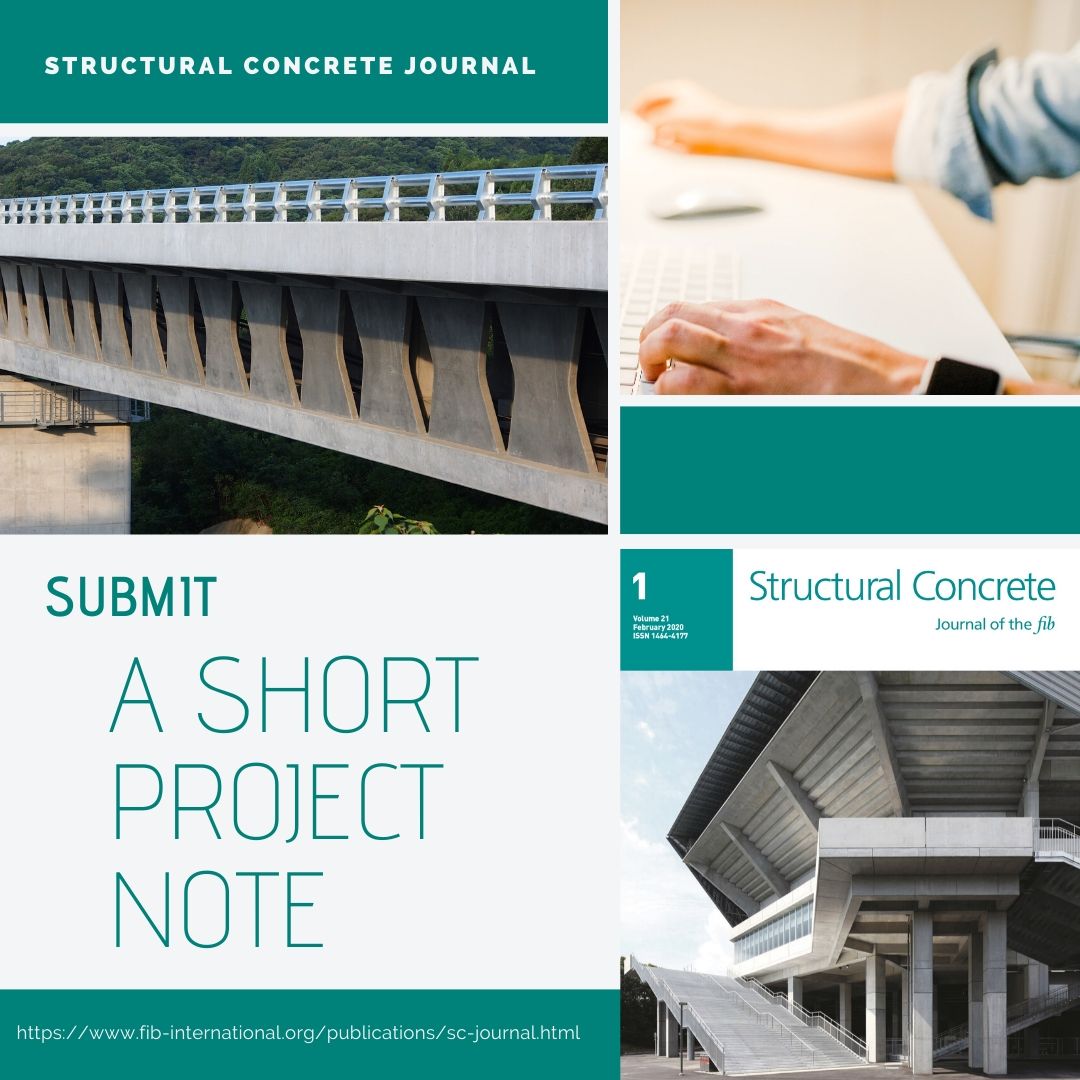
Structural Concrete, the official journal of the fib, provides conceptual and procedural guidance in the field of concrete construction and features peer-reviewed papers, keynote research and industry news covering all aspects of the design, construction, performance in service, conservation (assessment, maintenance, strengthening) and demolition of concrete structures, research about the behaviour of concrete structures, development of design methods, fib Model Code, sustainability of concrete structures.
fib Members can
 the SC Journal issues on the fib website and download them from the fib bookstore, or download them from the Wiley Online Library. PDF articles are published since 2011.
Indexed in the Thomson Reuters (ISI) Web of Science since Volume 10 (2009), the journal now has an impact factor of 3.3 and is published six times a year. All members of the fib automatically get the latest issue of Structural Concrete, so the best way to stay informed (as well as the more convenient way to obtain the journal and other advantages) is to become a member of the fib. In order to access to the SC Journal electronically, fib members need to be logged in and follow the steps as per the FAQ.
Every issue of Structural Concrete also includes the fib’s quarterly newsletter, fib-news, which provides up-to-date information from the fib secretariat and the latest news about fib events, members and new publications.
SC Journal App
Structural Concrete now has its own app! This app allows fib members to:
- browse the journal’s articles
- save articles
- subscribe to specific keywords – you will get notifications every time an article of interest to you is available
- get the latest news from the fib directly on your phone
- access the fib-news directly from your phone
- and much more!
The app is available both on GooglePlay and on the AppStore.
Once you have downloaded it, please use your fib members credentials to log in.
Journal Article
The main part of the journal contains peer-reviewed papers. The table of contents and abstracts for issues from 2002 to 2011 are freely available via Wiley Online Library.
Other free issues in Structural Concrete
The fib prides itself on the quality of its publications. The Federation has decided to make some of them available free of charge. Our free documents include the first completed drafts of the 2010 Model Code and the Award for Outstanding Concrete Structures brochures.
Besides the publications shown above, you can have a free access to the following publication:
Submission of papers
Structural Concrete is seeking original papers of the highest quality for publication. Papers may cover all aspects of the design, construction, performance in service, strengthening and demolition of concrete structures, including papers on research into the behaviour of structures and into the development of design methods. All papers will be subjected to a rigorous peer-review process prior to acceptance for publication. Author guidelines and manuscript submission information are available. Thus, for submitting a paper or Special issue in the SC Journal, please read and follow the Special Issue Policy.
Publisher: fib - International Federation for Structural Concrete. ISSN: 1464-4177 (print). 1751-7648 (online).
Editorial Board Editor-in-Chief
Luc Taerwe (Belgium)
Deputy Editor-in-Chief
Akio Kasuga (Japan)
Associate Editors-in-Chief
David Fernandez-Ordoñez (Switzerland)
Eduardo Julio (Portugal)
Sylvia Keßler (Germany)
Tamon Ueda (Japan)
Robert Vollum (UK)
Guang Ye (Netherlands)Members
Carmen Andrade (Spain)
György L. Balázs (Hungary)
Josée Bastien (Canada)
Oguzhan Bayrak (USA)
Beatrice Belletti (Italy)
Mikael Braestrup (Denmark)
Robby Caspeele (Belgium)
Íria Lícia Oliva Doniak (Brazil)
Vyacheslav Falikman (Russia)
Michael Fardis (Greece)
Miguel Fernández Ruiz (Spain)
Stephen Foster (Australia)
Albert De La Fuente Antequera (Spain)Venkat N. Heggade (India)
Sung Gul Hong (Korea)
Giuseppe Mancini (Italy)
Guilhemo Sales Melo (Brazil)
Mario E. Rodriguez (Mexico)
Theodoros Rousakis (Greece)
Alfred Strauss (Austria)
Miroslav Sykora (Czech Republic)
Jean-Michel Torrenti (France)
Roman Wan-Wendner (Belgium)
Feng Xing (China)
Yong Yuan (China)
Bin Zhao (China)EDITORIAL ADVISORY BOARD Members
Erkan Akpinar (Turkey)
Baraa Al-Eliwi (Iraq)
Farhad Aslani (Australia)
Panagiotis Asteris (Greece)
Jesus Miguel Bairan (Spain)
Yu-Lei Bai (China)
Jiuwen Bao (China)
Ahmet Benli (Turkey)
Agnieszka Bigaj (Netherlands)
Wouter Botte (Belgium)
Joan Casas (Spain)
Airong Chen (China)
Vladimir Cervenka (Czech Republic)
Antoni Cladera (Spain)
Marten Classen (Germany)
Antonio Conforti (Italy)
Tommaso D’Antino (Italy)
Jorge de Brito (Portugal)
Wouter De Corte (Belgium)
Gerrie Dieteren (Netherlands)
Hiroshi Dobashi (Japan)
Piotr Dybel (Poland)
German Ercolani (Argentina)
Duarte Faria (Switzerland)
Alessandro Fantalli (Italy)
Emmanuel Ferrier (France)
Pietro Gambarova (Italy)
Dan Gan (China)
Hans Ganz (Switzerland)
Joost Gulikers (Netherlands)
Muhammad Hadi (Australia)
Ahmed Hamoda (Egypt)
Steinar Helland (Norway)
Max Hendriks (Netherlands)
Majid Kadhim (Iraq)
Chris G. Karayannis (Greece)
Jacek Katzer (Poland)
Satoshi Komatsu (Japan)
Qing Quan Liang (Australia)
Guan Lin (China)
Bui Van Hong Linh (Vietnam)
Faqi Liu (China)
Qing-feng Liu (China)
Xian Liu (China)
Shasha Lu (China)
Zheng Lu (China)
Enzo Martinelli (Italy)
Stuart L. Matthews (UK)
Alberto Meda (Italy)
Marco Menegotto (Italy)
Tao Meng (China)
Giovanni Metelli (Italy)
Roberto Nascimbene (Italy)
Mahdu Nematzadeh (Iran)
Camillo Nuti (Italy)
Vincent Oettel (Germany)
Maurizio Orlando (Italy)
Alejandro Pérez Caldentey (Spain)
Norbert Randl (Austria)
Rafael Ruiz (Spain)
Łukasz Sadowski (Poland)
M. Neaz Sheikh (Australia)
Justin Shrestha (Australia)
Nikola Tošić (Spain)
Taner Ucar (Turkey)
Yuichi Uchida (Japan)
Ramin Vaghei (Malaysia)
Philippe Van Bogaert (Belgium)
Pieter van der Zee (Belgium)
Kim Van Tittelboom (Belgium)
Gideon van Zijl (South Africa)
Jan L. Vitek (Czech Republic)
Phillip Visintin (Australia)
Marcelo Waimberg (Brazil)
Joost Walraven (Netherlands)
Xin Wang (China)
Yi Wang (China)
Simon Wijte (Netherlands)
Miao Wu (China)
Jianzhuang Xiao (China)
Weichen Xue (China)
Carlos Zanuy (Spain)
Dawei Zhang (China)
Othman Zinkaah (Iraq) -


E-commerce
In addition to the Structural Concrete journal, the fib disseminates the following publications to its members, and also to the public. The publications included on the website are those currently available; a listing of all (including online) publications may be obtained by contacting the fib secretariat.





National groups logos